One Network. Every Partner Connected.
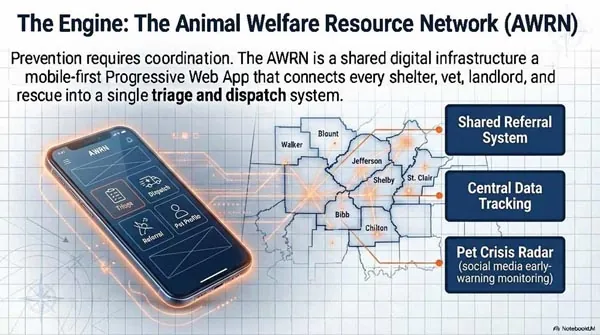
Right now, every shelter, rescue, and vet clinic in your area runs a separate system. None of them talk to each other. AWRN changes that. One platform. Every partner connected. Real time.
The Problem
Right now, your organization runs on one system. The shelter down the road runs on another. The vet clinic uses a third. None of them talk to each other. When a family calls you for help, you cannot see what the rescue across town has available. When they call the rescue, the rescue cannot see what you already tried.
Animals fall through the cracks. Families give up. And your team wastes hours on phone calls that a shared system would handle in seconds.
What AWRN Changes
AWRN puts you on the same platform as every other partner. The network routes the right referral to you automatically, already triaged, so you are not digging through a directory to find who can help. When a request lands outside your lane, you hand it back to the network with one step and it goes to the partner who can take it. You track prevention outcomes across the whole network.
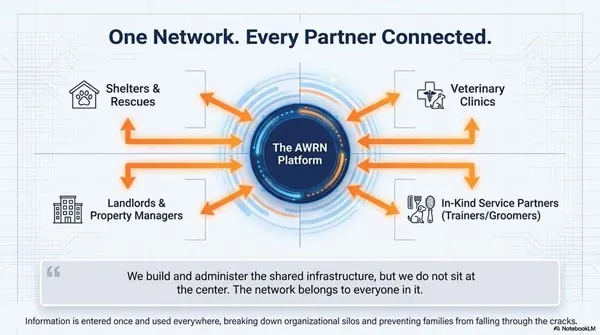
Animal-Angels Foundation builds and administers the infrastructure. But the network does not revolve around us. It connects you to everyone, and everyone to you.
Where AWRN Sits in the Prevention System
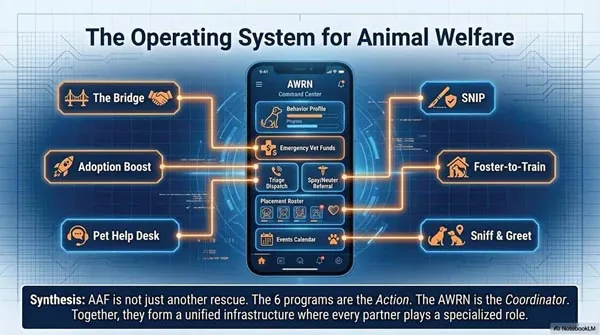
Animal-Angels Foundation operates across all three levels of prevention in animal welfare, following the public health framework that fire departments, hospitals, and community health systems have used for seventy years. AWRN is the coordination layer underneath all three tiers.
Stop the surrender call from happening.
SNIP, the Bridge, Pet Help Desk, and Landlord Partnership keep families and pets together so the shelter never receives an intake.
Catch the high-risk transition.
Sniff and Greet, Foster-to-Train, Adoption Boost, and Managed Rehoming reduce the chance that a return becomes a second surrender.
Reduce downstream impact.
AAF supports tertiary work through partner organizations rather than running these programs directly.
The Coordination Layer
AWRN sits underneath all three tiers, connecting every partner working in any tier of prevention. The network routes each referral to the right partner automatically, already triaged, and lets any partner hand a request back when it falls outside their lane. AAF builds and maintains the shared infrastructure. The network belongs to every organization in it.
Built for the Way You Work
You choose how deep you go. Run the AWRN alongside your current software and tap into the network. Synchronize your animal records so the automations work for you. Or use it as your full operations platform. Every organization is different, and the AWRN adapts to fit.
Partner Directory
You see every partner in the network and they see you. Services offered, contact info, and service area, updated in real time so you always know who can help and who needs help.
Shared Referral Pathways
When a family needs something you cannot provide, you find who can in seconds. Referrals are tracked so nothing falls through the cracks and you can see outcomes.
Capacity Broadcasting (coming soon)
On the near-term roadmap: broadcast your available kennel space, foster openings, appointment slots, and program availability so every partner sees it instantly. No more phone tag to find an open spot.
Intake Diversion Tracking
Every time a partner prevents a shelter intake, it gets recorded. You see your own numbers and the network-wide impact. Real data that proves prevention works.
Crisis Radar
AAF runs automated monitoring of social media, news, and community channels for emerging animal welfare situations across the network. When something surfaces in your area, AAF routes it to the right partner so you can respond early instead of react. Crisis Radar and the Intelligence Center are operated by AAF.
Prevention Data
You see your own prevention numbers and your county's network impact. The full network-wide dashboards across every county live in AAF's Intelligence Center, with advanced reporting available as an optional upgrade. Real data that helps you make decisions and prove impact to your funders.
How the network decides who gets a referral
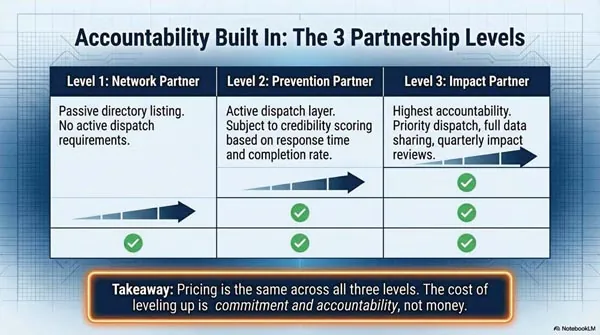
Every partner has a credibility score, and it is the only thing that decides who gets the next referral. You start in good standing the day you join. Accept referrals and see them through, and your score climbs, which sends you more. Turn one down cleanly and fast, that costs you nothing. What costs you is going silent on a family who is counting on you. Reliability earns referrals here. Nobody ever pays to jump the line.
Three Ways to Connect
Whether you already have software you love or you need a full operations system from day one, the AWRN meets you where you are.
Network Only
Keep your current software. The AWRN adds a shared network layer on top: referral pathways, capacity broadcasting, crisis alerts, and partner directory access. You get the full network without changing how you operate day to day.
Synchronized
Connect your animal records to the AWRN so the automations work. Lost pet reports match against your intake records automatically. Adoption outcomes feed into network-wide reporting. Foster placements sync across partners. Your data stays in your system and flows into the network at the same time.
Full Platform
Use the AWRN as your primary operations system. Shelter intake and outcomes, foster management, volunteer tracking, adoption follow-up, reporting, and full network access all in one place. Built for shelters and rescues that want everything on a single platform without paying for multiple subscriptions.
What the Platform Does
Every feature is customizable to your organization. You see what matters to your work, configured the way you need it.
Shelter and Rescue Operations
You track every intake, outcome, transfer, and length of stay from one dashboard. Everything categorized by SPCA and Shelter Animals Count 2025 standards. Real-time alerts flag patterns like rising euthanasia rates or intake spikes before they become crises.
Foster and Volunteer Management
You manage your foster homes, placements, durations, and outcomes in one place. You handle volunteer applications, hours, skills, and assignments. Match your fosters to animals based on experience, capacity, and location. All connected to the network so you can share foster resources with other partners.
Adoption Tracking and Follow-Up
You track every adoption from application through placement. Automated 30, 60, and 90 day follow-up reminders keep you connected. You catch returns early and deliver Adoption Boost support resources to your adopters at the right moments during their first 90 days.
Pet Help Desk and Dispatch
You triage incoming calls and route them to the right resource in seconds. The dispatch system sends your requests across the network with priority tiers. Urgent cases auto-dispatch. Every call is logged, every outcome tracked. The family never has to tell their story twice.
Resource Library and Document Repository
A shared knowledge base for the entire network. Training materials, program guides, best practices, and templates that every partner can access. Version controlled with audit trails so you always have the current document. Partners contribute resources and everyone benefits.
Reporting and Analytics
Customizable dashboards for every organization. See your own numbers alongside county, regional, and national benchmarks. Generate reports for funders, board meetings, and grant applications with real data. Track the metrics that matter to your work, not a one-size-fits-all template.
Every Partner Has a Role
Shelters, rescues, vet clinics, landlords, community organizations, municipal agencies, and pet owners. If your work touches animals or the families who love them, there is a seat at the table.
Shelters and Rescues
Broadcast capacity, receive diversions, connect surrendering families to prevention resources before intake. Fewer animals in, more going home.
Veterinary Clinics
Participate in SNIP referrals, provide crisis veterinary care through The Bridge, and connect clients to the full network when they need help beyond medical.
Landlords and Property Managers
Access pet resumes, anti-damage prevention kits, and a direct line to AAF when tenant pet issues come up. Reduce pet-related turnover and keep residents stable.
Community Organizations
Food banks, churches, social services, and housing agencies that see families in crisis. Connect them to prevention resources before the pet becomes the thing that gets cut.
Animal Control
Diversion pathways for non-emergency calls, shared data on repeat addresses, and direct connection to crisis stabilization resources. Fewer seizures, better outcomes.
See the budget case for your county →National Organizations
AWRN is built to scale. If you do prevention work anywhere in the country, you can join the network, access the shared infrastructure, and connect to every other partner on the platform.
Trainers and Behaviorists
Receive referrals for families dealing with behavior issues that put pets at risk of surrender. Offer training through Foster-to-Train, support Bridge cases, and connect clients to the full network when they need more than training alone.
Groomers and Pet Services
Groomers, pet sitters, boarding facilities, and other pet service providers. You see animals and families regularly. When something looks off, you have a direct line to get them help before the situation gets worse.
Pet Owners and Families
Call the Pet Help Desk when you need help with anything from emergency pet food to behavior support to housing challenges. The network connects you to the right resource in minutes. You do not have to figure it out alone.
The Prevention Case for Your County
AAF estimates Alabama taxpayers spend $35 to $50 million annually on reactive animal control, based on ASPCA national shelter cost data scaled to Alabama's intake volume. Prevention costs approximately $44 per intervention (based on AAF Sponsor Impact Calculator methodology). Shelter intake costs $400 to $500 per animal (ASPCA). We built the full budget case so you can share it with your commissioners, your council, or your budget office.
Transparent. Simple. Built to Scale.
Every plan includes 5 users. Additional blocks of 5 users are $79 per block. Tier 3 and Tier 4 sponsors get unlimited users at no charge.
Shelters and rescues always join free.
Full platform access, partner directory, referral pathways, and 5 users at no cost, with capacity broadcasting coming soon. Optional reporting upgrades are available for organizations that want advanced analytics.
Founding window pricing. When the AWRN reaches full operating capacity, rates increase 25 to 30 percent. Partners who join now lock in current pricing permanently. Founding partners who join free keep free access for life. The window closes when we launch.
One Network. Nationwide.
AWRN launched in seven counties in Central Alabama. But wherever you are, the platform is built to reach you. The goal is to get every animal welfare organization in the country on the same system, connected to each other, sharing data and resources in real time.
When your shelter in Knoxville can see available foster homes in Birmingham, and your vet clinic in Colorado can refer a family to crisis support in Minnesota, the system works the way it should. Not you working alone. Everyone working together on shared infrastructure.
If you want to see it, we will show you. If you want to join, the door is open.
Common Questions About AWRN
Data Security and Privacy
For partners, families, and anyone who wants to know how we handle data.
For Partners
For Families and Individuals
How the AWRN Works
You connect to every partner. They connect to you. One shared platform. One prevention network.
Sources: Alabama animal control cost estimate based on AAF service area analysis using ASPCA national shelter cost data. Intervention cost of $44 based on AAF Sponsor Impact Calculator methodology. Shelter intake cost range of $400 to $500 per animal from ASPCA. Intake categorization follows Shelter Animals Count 2025 reporting standards. Data retention periods and breach notification targets reflect AAF internal policy commitments. Partner pricing reflects AAF founding window rates.